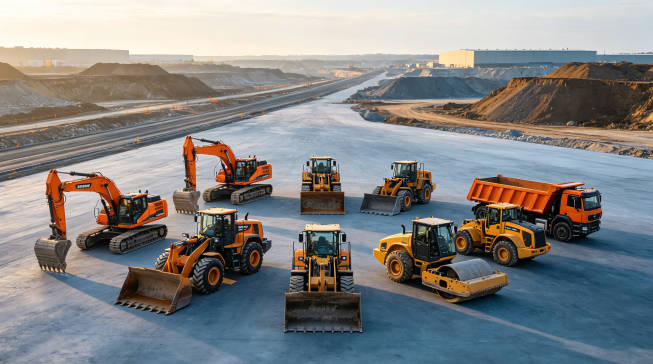
Managing heavy equipment across multiple construction, mining, and infrastructure projects requires more than simply purchasing powerful machines. Different projects involve different working conditions, workloads, transportation requirements, and production targets. Building a well-matched equipment fleet can help contractors improve utilization, control operating costs, and maintain consistent project performance.
The first step in fleet planning is to understand the work that needs to be completed. Excavation, earthmoving, material handling, road construction, lifting, and site preparation require different types of equipment.
For example, excavators are suitable for digging and loading operations, while wheel loaders can efficiently handle bulk material transportation and stockpile management. Bulldozers are useful for pushing, grading, and site preparation, while motor graders are designed for precise road and surface leveling.
Instead of selecting machines based only on horsepower or operating weight, fleet configuration should be based on the expected workload, jobsite conditions, and daily operating hours.
Oversized equipment is not always the most efficient choice. A large excavator may provide excellent digging performance, but it can be difficult to transport and operate efficiently on a confined urban construction site.
On the other hand, equipment with insufficient capacity may require longer operating cycles and increase fuel consumption and labor costs.
A balanced fleet should include machines with complementary capacities. Matching excavators, loaders, dump trucks, and other equipment can create a smoother material-handling cycle and reduce waiting time between operations.
For contractors working on multiple projects, equipment mobility is an important part of fleet planning.
Machines may need to be transported between construction sites, mining areas, ports, or infrastructure projects. Transportation dimensions, operating weight, loading methods, and regional road regulations should therefore be considered before purchasing equipment.
A machine that performs well but is difficult or expensive to relocate may increase the total cost of a project.
Construction and mining conditions can vary significantly. Equipment working in high-temperature regions, mountainous areas, muddy terrain, or dusty environments may require different configurations and component specifications.
Engine performance, hydraulic capacity, cooling systems, tires or tracks, attachments, and operator protection should all be evaluated according to the actual working environment.
Choosing equipment according to operating conditions can help improve machine productivity and reduce unnecessary equipment limitations during daily operations.
Fleet efficiency is closely related to how frequently each machine is used.
When several machines perform overlapping functions, some equipment may remain idle for long periods. A better approach is to create a fleet in which each machine has a clear role while still providing enough flexibility for changing project requirements.
Attachments can also increase equipment versatility. Excavators, loaders, and other machines can be configured for different tasks through suitable buckets, breakers, forks, grapples, and other working tools.
This allows contractors to handle more applications without purchasing a completely separate machine for every task.
Equipment procurement should not end when the machine arrives at the jobsite. Long-term fleet performance depends on reliable parts supply, technical support, maintenance resources, and communication with the equipment supplier.
For international buyers, factors such as export experience, shipping coordination, documentation, spare parts availability, and after-sales support are particularly important.
A supplier with an established global service and supply chain can help customers manage equipment procurement more efficiently and respond faster when project requirements change.
The purchase price is only one part of the investment.
A practical fleet evaluation should consider fuel consumption, transportation, maintenance, spare parts, operator requirements, expected service life, resale value, and equipment utilization.
By evaluating total cost of ownership rather than focusing only on the initial purchase price, contractors can make more informed equipment decisions and build a fleet that delivers long-term value.
OKV Machinery provides construction machinery and related equipment for customers working across different international markets. Our product range covers excavators, loaders, bulldozers, motor graders, road rollers, truck cranes, crawler cranes, piling machinery, asphalt pavers, heavy-duty trucks, and spare parts.
With experience in international equipment trading, shipping coordination, spare parts supply, and after-sales support, OKV Machinery helps customers select equipment according to project requirements rather than simply offering individual machines.
Whether you are developing a new equipment fleet or expanding an existing one, the right combination of machines, specifications, logistics, and support can make a significant difference to project efficiency and long-term operating costs.